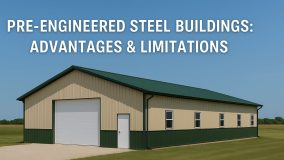
What are cold formed buildings?
When thinking about steel buildings, most people usually think of one of the two possible extremes - the little tubular metal building in a neighbor’s backyard or a vast, red-iron metal building in the business and industrial park. It’s almost always one of these two that pops into people’s minds.
Today, we are shining the light on another popular type of metal building kit that is simple enough to use in the backyard but flexible enough for the business and industrial park. This article will explain why cold-form (CF) steel buildings might be the best choice for your next project.
Alternate metal building systems include pre-engineered metal buildings (PEMB), structural steel buildings, and arch steel buildings.
Key takeaways
This article will explain how cold-formed steel buildings:
- Expedite construction time
- Reduce construction expenses
- Are environmentally friendly
- Have a long lifespan
- Are a modern, fire-resistant building solution
Often thought to be a new construction material, cold-formed (AKA cold rolled) steel was first used in construction in the 1850s. In 1925, the Virginia Baptist Hospital in Lynchburg, Virginia, was constructed with cold formed steel. While this was considered the first documented use of CF steel as a building material, its popularity was about to rise.
In 1933, three CF steel homes, dubbed the “home of the future,” were on exhibit at what is now known as the World’s Fair in Chicago. This exposure and the housing crises after World War II led to a huge demand of these homes, especially after being advertised as being built in a day.
By 1950, Lustron Corporation had built 2,500 homes in 36 states. It was such an adaptable material that these homes also used CF steel in their cabinetry and furniture.
Get Four Estimates
Compare prices from local suppliers and save
What is cold-formed steel?
Cold formed steel is thin but very strong steel formed by rollers, presses, and dies at ambient temperature. Due to being formed while cold, the metal does not lose its hardness or shape.
We are surrounded daily by cold-formed steel. Automobiles, appliances, dwellings, and other structures use CF steel. Framing, as well as roof and wall cladding, use cold-formed steel in construction.
What are cold-rolled steel buildings?
Cold formed steel buildings are pre-engineered clear-span buildings that use c-channels for their primary framing’s columns and rafters instead of rigid frames or hot-rolled sections, as other metal building systems might use.

Advantages of cold form metal buildings
Durability and strength
Cold-formed metal buildings are very strong, and the manufacturing process results in consistently well-shaped, straight members. CF steel doesn’t shrink, warp, or crack as wooden framing members can.
Resistance to corrosion and pests
CF steel consists of coated or galvanized coils and sheets, which makes it resistant to moisture. Steel’s natural properties prevent it from being damaged by termites and other pests.
Longevity of structures
Although 50 years is commonly published, the lifespan of a cold-formed steel building is virtually endless when fabricated and installed correctly. Like wood and other materials, cold-formed steel’s unique properties do not lessen over time.
Reduced foundation costs
Concrete is the single most expensive material in construction. With c-channel buildings being lighter in weight than other types of metal, the footings are smaller, and less rebar is required. Minimizing foundation costs by as much as 30%.
Environmental benefits
Cold formed steel fabrication leaves the smallest footprint on our environment. The coils and sheets are created from recycled steel and formed at room temperatures instead of the extreme temperatures of furnaces. This reduces carbon emissions. With each piece fabricated to specific dimensions, CF building kits leave little waste.
Sustainability and recyclability
Steel is recyclable, and the steel bought today contains recycled steel. So, cold formed steel is a sustainable resource that gives back to itself.
Energy efficiency
Cold-rolled steel buildings are tightly sealed and easily insulated, making them energy efficient. They can also meet the standards of Energy Star, LEED, and other environmental benchmarks.
Cost-effectiveness
Cold form steel structures are the most economical building solution available. First, steel is sold by the pound.
Since cold-formed is lightweight and easier to produce than other types of metal, it’s cheaper to purchase.
Next, their lightweight uses smaller footings, reducing concrete expenses.
Cold form building kits arrive with components precut to the proper length. Each piece is ready to be bolted or screwed together. These pre-fabricated benefits reduce labor costs and material waste.
Finally, CF buildings are virtually maintenance-free, so the savings continue throughout the life of the building.
Versatility in design and applications
Cold form framing is available in several profiles, making it versatile for architectural design and construction.
Its clean, consistent form works well with glass, wood, and other materials to create complex, modern structures. It’s also simple enough to be used in basic applications, like steel-framed garages.
Fire resistance and safety
CF steel’s fire resistance is unmatched by materials like wood. Steel doesn’t burn, and its melting temperature is around 2,470°. A dry, wooden 2”x4” can ignite at temperatures as low as 200°.
In the event of a fire, steel’s higher melting temperature allows time for occupants to make their way to an exit.

3D Design your building
Visualize your ideal structure with our intuitive metal building designer
Limitations of cold-formed buildings
While cold-form buildings fit a broad span of applications from aesthetically appealing commercial buildings to garages and other low complexity needs, they work best when:
- They are 40’ wide or less
- Their maximum height is 20’ or less
- Their roofs are gabled
- Used for low-complexity designs
Not used in applications where cranes, hangar doors, mezzanines, and other significant loads exist
Typical cold form metal building applications
Cold form buildings are versatile and cost-effective, making them suitable for various applications. These popular structures, from agricultural storage and workshops to retail spaces and residential garages, demonstrate durability, flexibility, and quick assembly.
Commercial
Cold form steel buildings work well in commercial applications. They are quickly fabricated and easily erected, and their clear-span nature offers maximum floor space. These qualities make them ideal for retail applications, warehouses, and storage buildings.

Residential applications
Cold-formed structures are excellent options for residential home and shop house applications. The framing is straight, clean, and shallow in depth, making the components easy to work with and easily concealed behind drywall.

Agricultural and other uses
Quickly erected, CF buildings serve agricultural markets well. Their clear-span nature offers effective storage and shelter for equipment, feed, and livestock.

Self-storage buildings
CF building kits are very popular in the self-storage industry because of their ease of construction and duplication.

Get Four Quotes
Compare estimates from local suppliers & save
Construction process
CF steel buildings are a type of pre-engineered metal building (PEMB). The supplier custom designs them to fit customers’ needs and fabricates them in their shop.
The metal components are delivered pre-cut to length with drilled connection holes. It can be easily assembled following the manufacturer’s erection drawings.

Typical costs
Initial costs vs. long-term savings
As a PEMB, CF has a higher initial cost due to the design and manufacturing processes. However, the speed and ease of the erection process quickly offset the higher initial cost. Framing members are already cut to length and ready for connections, reducing labor rates.
Additionally, metalrequires little to no maintenance and is resistant to rot, termites, and other destructive factors that wood or other materials experience. Also, property insurance costs less for CF structures due to their structural integrity.
As shown, the higher initial cost of steel is brief compared to the long-term savings.
Cost comparison with other building materials
CF metal members cost more than wooden members, but that is the extent to which wood is less expensive. Wooden members are heavier and more challenging to handle while installing, requiring more workers.
Each piece of wood requires measuring and cutting on the job site. This takes time, which increases labor costs. It also increases safety risks for the workers.
Precision cuts and knowledge of proper framing practices require skilled workers. CF building kit components are pre-fabricated and ready to bolt or screw together on-site.
So, while wood is cheaper per piece, labor demands make it more expensive overall. But, wood’s additional costs do not stop there.
Wood requires ongoing maintenance to prevent mold, rot, and termite infestation. Additionally, as wood dries, it becomes easier to ignite. It’s also not as durable as steel in harsh weather environments. These issues lead to higher property insurance costs for wooden structures.
Factors influencing the overall cost
In a nutshell, a project’s total cost has more variables than just material cost. Labor, construction time, and insurance premiums require consideration to evaluate overall cost accurately.
Cold formed steel vs Red Iron
CF buildings and most red iron (RI) buildings are pre-engineered building systems (PEMB). Both provide construction advantages over wood and other construction materials. However, there are stark differences between the two products and their ease of use. Let’s take a closer look.
Materials
Cold-formed steel members begin as galvanized or pre-primed coils ranging in thickness from 10-gauge to 18-gauge, or roughly a little more down to a little less than one-eighth of an inch. A machine shears the coils to their required lengths. Next, they are passed through rollers and dies, forming them into C, Z, or U-sections, hat channels, angles, and other shapes.

As the name implies, cold-formed steel’s shaping occurs at room temperature. Minimum welding is required.
RI, sometimes called hot-rolled steel, begins as a solid slab or billet. A furnace heats the billet to extreme temperatures over 2,000°. While hot, the billet passes through rollers, which apply pressure, forming them into I, C, and other shaped members, each having different structural properties.
Rigid frames are another building system sometimes referred to as red iron. Rigid frame assemblies consist of two flanges and a web welded to form an I-shape. Cut flat plates of metalform the flanges and web.
RI production involves shop and field welding, increasing lead times due to extended fabrication processes.
Construction
The physical weight difference between CF and RI affects every aspect of construction, from delivery to installation to safety.
CF building components are bundled and delivered to the job site on pallets. Red iron, which is much heavier, usually requires many more deliveries so that the trucks comply with DOT laws.
Once unloaded, the kit components are light enough for workers, forklifts, or other small equipment to move it. Due to its weight, red iron requires a crane to offload and move each piece of it throughout the erection process.
Another key difference between CF and RI is how they assemble. CF workers can hold or clamp pieces while screwing or bolting them together.
RI connections may require welding or bolting for assembly. In either case, the heavy members are suspended in the air by a crane while the worker is on a lift, trying to connect them.
RI construction creates more safety risks and physical challenges for workers, who have to wrestle the heavy beams incrementally into place for the connection while both are in the air.

Foundations
The columns of CF structures are light in weight and support less loads than RI columns. Therefore, the concrete footings beneath them are smaller than those under red iron columns.
The footings and foundation can be poured simultaneously for CF buildings. However, red iron requires at least two pours due to the substantial size of its footings. The footings are poured first, and later, the remaining concrete is poured.
Costs
We’ve already addressed many ways CF costs less than RI, like cost per pound, shipping charges, job site labor, concrete, and property insurance. But there are layers of other expenses to consider
CF buildings are produced more quickly in the supplier’s manufacturing facility since it is primarily an automated process requiring little human labor. It’s thin enough to be sheared to length and have its holes punched and requires little welding.
Red iron, on the other hand, requires more attention from shop workers. It’s too thick to shear, so it must be cut by hand, which is slower. Its thickness also requires connection holes to be drilled instead of punched. Again, this is slower.
Additionally, some RI beams require multiple plates, which means workers must handle and cut more pieces. Once cut, these plates need welding together.
Time spent by shop employees is a cost passed down to the customer.
Due to the weight, RI construction requires a crane for the project’s duration, so equipment rentals cost more.
CF projects are generally smaller in size and require fewer workers. A smaller labor crew not only saves on physical labor costs but also saves on Workman’s Compensation insurance.
The user-friendliness of CF construction reduces construction time. This is helpful to owners with construction loans, as their exposure to interest fees is minimal.
Cold-formed construction provides many savings opportunities from beginning to end.
Final thoughts
Cold-formed steel buildings check all the boxes on everything important to a construction project: quick deliveries, easy installation, structural integrity, cost-efficiency, low maintenance, environmentally friendliness, and safety.
Still, some people will default to wood for their project because of the misconception that wood is cheaper. Before you make a decision, do your due diligence. Here’s why:
A 2019 study by R.A. Smith, Inc. found that wood and steel cost about the same once all expenses, including insurance, are considered.
So why not make it easier on yourself and have a better structure that is simple to erect and requires less maintenance?
Let us help you find the best building solution for sale ......
To learn more about how a red iron building can work for your project or to receive personalized quotes from four leading suppliers, our team is ready to help you find the best solution from our network of trusted manufacturers.
For a comprehensive list of PEMB terminology, see our steel building glossary page.
Frequently asked questions
-
How long do cold-form buildings last?
Buildings fabricated from quality galvanized or coated material and properly erected will last at least 50 years. In all likelihood, they will last longer since metal doesn’t deteriorate.
-
How does cold-form compare to hot rolled steel?
CF steel is light in weight yet has incredible structural properties and strength. Due to the manufacturing process, its dimensional properties are more accurate and more consistent. Hot-rolled steel is more suited for large construction projects where higher design loads are supported.
-
Are CF buildings energy-efficient?
Yes, as buildings are easily insulated and tightly sealed, making them energy-efficient.
-
Can cold-form steel be used in residential construction?
Yes, it has been used in residential construction since the 1940s.
-
Can CF buildings be customized?
Yes, it’s adaptability to various architectural styles and construction demands is one reason this product is so popular. It serves the needs of different building styles, from simple garages to eloquent residential and commercial structures.